

Cross-Chain Bridges: Why Your Assets Move Between Blockchains (and What Can Go Wrong)
If you've ever moved Bitcoin to Ethereum or swapped assets across chains, you've relied on a bridge—a mechanism that lets cryptocurrencies flow between isolated blockchains. Understanding how bridges work, their trade-offs, and the risks they carry is essential for any trader managing positions across multiple chains or experimenting with yield strategies on different networks.
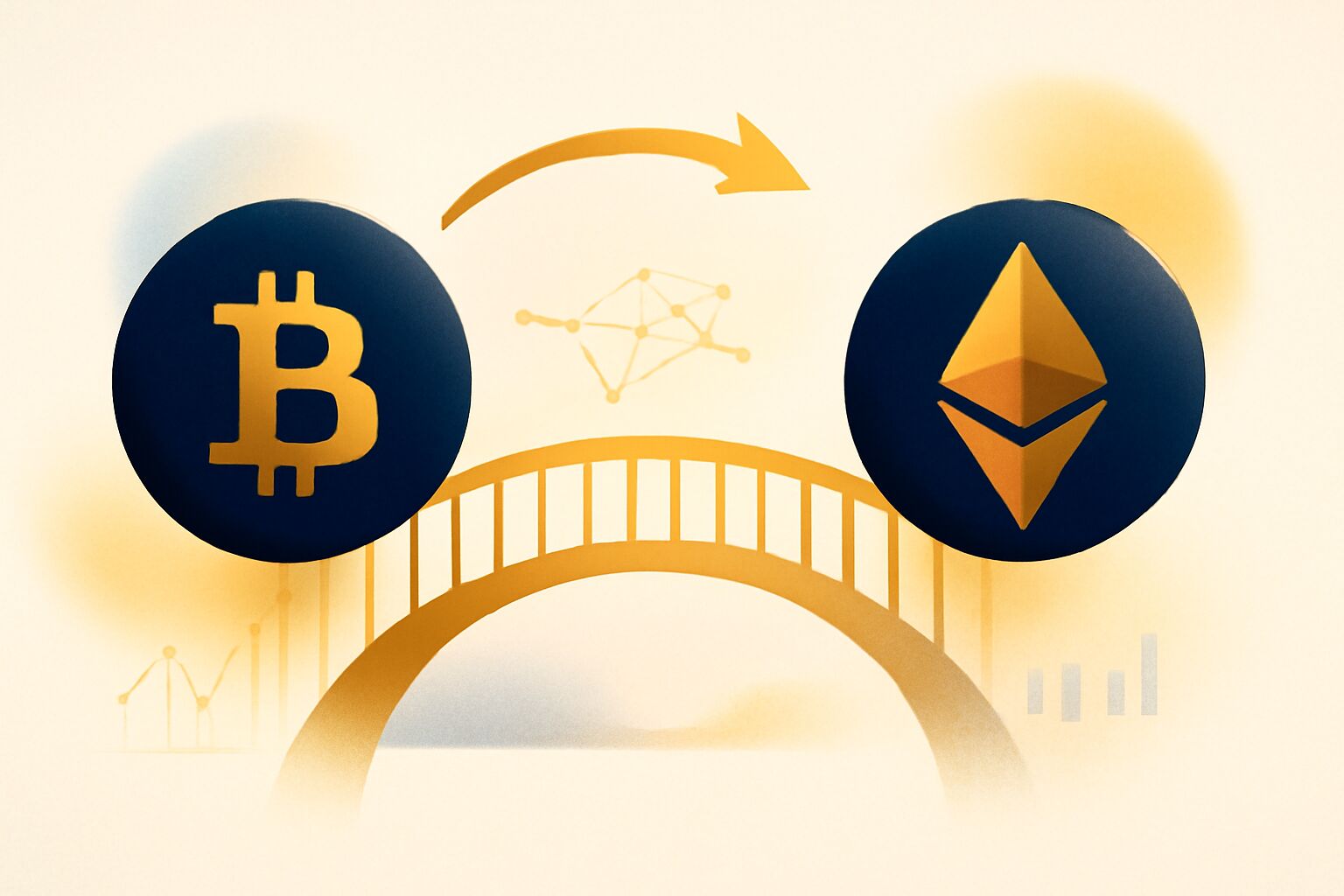
The Problem: Blockchains Are Isolated by Design
Bitcoin and Ethereum operate as separate ledgers. Bitcoin can't directly "know" about Ethereum transactions, and vice versa. Each blockchain maintains its own state, validates its own transactions, and has no native way to communicate with others.
For a trader, this isolation creates friction. If you own Bitcoin but want to deploy it in an Ethereum-based DeFi protocol to earn yield, you can't just send your BTC to an Ethereum address—it won't arrive. The networks don't speak the same language.
Historically, moving assets between chains meant trusting a centralized exchange (Coinbase, Kraken) to take your Bitcoin, hold it, and send you IOUs on Ethereum. You lose custody during the swap, pay fees, and expose yourself to counterparty risk. This is exactly the kind of friction that decentralized finance was designed to eliminate.
Wrapped Tokens and Token Bridges: The Practical Solution
A token bridge solves this by creating a representation of your asset on a new chain. Here's the mechanism:
1. Lock: You send 1 Bitcoin to a bridge contract on Bitcoin. That contract holds your BTC in custody. 2. Mint: The same bridge contract on Ethereum creates 1 wrapped Bitcoin (wBTC, an ERC-20 token) in your Ethereum wallet. 3. Redeem: Later, you can burn the wBTC on Ethereum, and the bridge releases your original Bitcoin back to you on Bitcoin.
The "wrapping" preserves the 1:1 peg with the original asset. On TradingView, you might trade wBTC on Ethereum-based pairs (wBTC/USDC) or monitor the peg on Uniswap charts. If wBTC ever trades below BTC by more than transaction fees, arbitrageurs step in to close the gap—a clear signal that bridge mechanics are working.
Other examples: Wrapped Ethereum (wETH) on Bitcoin sidechains, or wrapped Solana (SOL) on Polygon. Each one follows the same lock-and-mint pattern.
Alternative Mechanisms: Atomic Swaps and IBC
Bridges aren't the only way to move value across chains.
Atomic swaps use smart contracts to enforce a simultaneous exchange: you trade your Bitcoin for someone else's Ethereum, and both legs settle at the same time or not at all. If one party fails to fulfill their end, the entire swap cancels and assets are returned. This is trustless (no intermediary required) but requires a counterparty on the other side of the trade, which limits liquidity.
Inter-Blockchain Communication (IBC) is a protocol used by Cosmos and compatible chains. Instead of locking and minting tokens, IBC allows blockchains in the same ecosystem to exchange messages and verify each other's state directly. It's faster and more elegant for networks designed to work together, but only works within ecosystems that implement IBC—Ethereum and Bitcoin, for instance, don't support it natively.
For most traders, wrapped tokens and bridges are the practical reality: they offer the deepest liquidity and the widest asset compatibility.
The Trade-Off: Convenience vs. Custody Risk
Every bridge introduces a trust assumption. Even the best-engineered bridges require you to trust:
- The bridge contract code: Bugs or vulnerabilities can lock assets or allow unauthorized minting. The Ronin bridge hack (2022) and Poly Network exploit (2021) each cost tens of millions because of flawed smart contract logic.
- The bridge operator(s): Centralized bridges rely on a small set of validators or operators to sign off on asset releases. If those operators are compromised or collude, funds can vanish.
- The oracle or lightclient: Some bridges rely on external data feeds to verify that you locked assets on the source chain. If the oracle is manipulated, wBTC could be minted without corresponding Bitcoin in custody.
This is why you'll see wrapped assets trade at a slight discount to their native counterparts during periods of bridge uncertainty—the discount is the market's estimate of counterparty risk. On a chart, watch for wBTC/BTC basis widening during regulatory or security scares; it's a real signal of bridge distrust.
The safest bridges use decentralized validators and multi-signature security, but they're slower and more expensive. The fastest and cheapest bridges often centralize risk. You're choosing between security, speed, and cost—never get all three.
What This Means for Your Trading
Understanding bridges changes how you think about liquidity, yield, and execution:
Liquidity arbitrage: If wBTC trades at a discount to BTC on Ethereum (Uniswap) while BTC itself is higher on spot exchanges, wrapping and unwrapping can be profitable—as long as bridge fees and slippage don't eat the margin.
Yield farming: Many of the highest yields live on smaller or newer chains (Arbitrum, Optimism, Polygon). To access them, you must bridge assets from Ethereum or Bitcoin. The bridge fee is a cost of entry; compare it against the protocol's APY to decide if it's worth it.
Risk management: If you're holding wBTC in a DeFi protocol and news breaks about a bridge exploit, the peg might crack immediately. A properly diversified cross-chain position should weight exposure to bridge risk—don't concentrate 100% of your BTC equivalent in a single wrapped form.
On TradingView: Set up watchlists for peg spreads (wBTC vs. BTC, wETH vs. ETH) on your preferred chains. Alert on 2-3% deviations, which often signal either arbitrage opportunities or early signs of bridge strain. When building multi-chain strategies or backtesting in PineMind with cross-chain data, account for bridge slippage and fees as realistic friction costs.